"Generally,
by the time you are Real, most of your hair has been loved off, and
your eyes drop out and you get loose in the joints and very shabby. But
these things don't matter at all, because once you are Real, you can't
be ugly, except to people who don't understand."
(from the Velveteen Rabbit, by Margery Williams)
Sunday, July 31, 2016
Saturday, May 7, 2016
LaPorte, Indiana by Jason Bitner and The Lone Surfer of Montana Kansas by Davy Rothbart
In the vein of things I like, which is as good a thing
as any to write about, I would like to honor our neighbors to the
north. No, not Canada. Some fellows from Ann Arbor, Michigan who are
just about the most interesting and creative people I've run across.
Davy Rothbart and Jason Bitner are the creators and editors of Found Magazine. If you haven't had a chance to visit the website, please do so now. I will wait for you... See now, wasn't that cool? I highly recommend getting your hands on a copy of the magazine though, it is even more interesting than the website.
Both Rothbart and Bitner have recent "solo" projects that are every bit as good as Found.

Jason Bitner has recently published LaPorte, Indiana, a lovely, thoughtful glimpse into the heyday of a small Midwestern town. LaPorte is composed entirely of photographs--studio portrait proofs which span the 1950's and 60's.
It would have been all too easy for Bitner to publish a snarky, post-modern book that points out the lapses of fashion sense, hickishness, and just basically mocks the folks of LaPorte for our amusement.
But what
Bitner has done is present these photos as little trinkets, little
shards of other people's life without judgement, or comment. These
little bits of ephemera can help us see the humanity in the extras that
wander through the movie of our life. LaPorte gives us glimpses
at the beginnings, middles and sometimes ends of stories, from people
frozen at a moment in time, a moment they wanted to memorialize.
As
a committed Midwestern gal myself, I felt the tug of home while reading
this book, and once again was captivated by the beauty and life that
surrounds us here in the heartland. No less than John Mellencamp, whom I
respect greatly has said about LaPorte: “These are real
people. The grace and dignity one sees in their faces should be a source
of hope for us all.” I second that emotion, and encourage you to take a
look

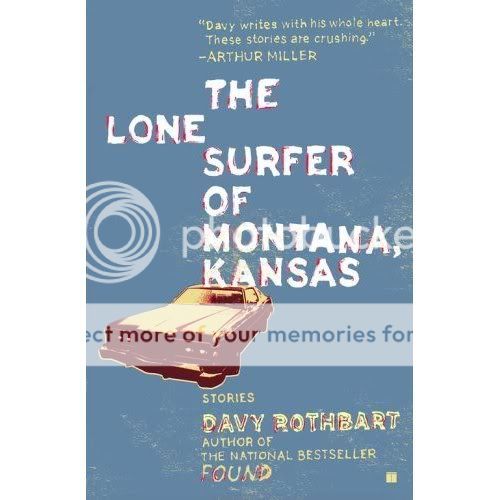
Davy Rothbart has released a collection of short stories, The Lone Surfer of Montana, Kansas.
This isn't to say that you won't laugh out loud while reading this book, Rothbart does an admirable job balancing pathos with just enough humor to keep it bearable, but not enough to make light, so that when the whole thing comes crashing down you are stunned by the suddenness and inevitability of it.
A
wonderful book by a writer with a sure, clear voice and a command of
the tricky language of non-preachy salvation. You can easily read this
book in an afternoon, but you'll be thinking about it for days to come.
So,
although I fear this will get me run out of Columbus on a rail, I tip
my hat to the boys from Ann Arbor, and look forward to hearing much more
from both of them.
Devil In the Details by Jennifer Traig
I'm not a great one for memoirs but as Jennifer Traig writes about a subject that affects several people I know, I simply couldn't resist.
Anne Lamott once said that what the world needed were more funny books about dealing with serious subjects (her book Hard Laughter is a case in point) Thankfully, Jennifer Traig has come along with just the funny book I needed.
As the subtitle "scenes from an obsessive girlhood" implies, Jennifer Traig has Obsessive Compulsive Disorder (OCD). She has bouts with a particularly nasty strain--scrupulosity, which is driven by severe and rigorous religious standards.
From several whirls with anorexia, to a personal strain of Judaism so strict she can't bathe for three weeks, eat meat and milk on the same day, or use the letter x (it's a cross, and to touch it means you've converted to Christianity) Traig describes it all from the inside. You wouldn't expect the next words out of my mouth to be "I laughed so hard my chest hurt" but that is in fact the truth.
With her ever changing compulsions, Traig gets herself into some pretty ridiculous situations, and she laughs right along with us. She hints at the unhappiness that (I can assure you) a teenager with OCD feels, and at family strife over her ever changing illness, but she doesn't dwell on it. Far from making fun of OCD, or glossing over the very real consequences of her behavior, Traig is looking fondly at her childhood--as any woman in her thirties would. The only difference is that most women in their thirties don't have memories of compulsory, hours-long, desperate tea rituals with stuffed animals. She is tender with both herself and her family, and the mistakes that, with the gift of hindsight, we can see they made in dealing with her disease. As she points out though, it was the mid-70's and OCD wasn't widely recognized. Through all the hand-washing, rituals, and miles and miles of paper towels the Traigs are held together by love.
As someone who lives with OCD, I know it is difficult to handle, and even harder to explain. Why am I tying and re-tying my shoes 15 times? I have no idea, but believe me, it looks more fun than it is. One of my own personal best answers to the persistent musical question: "Why don't you just stop that?" has always been "Sure. Just as soon as you just stop growing." Now I think I'll give this book to some people in my life, and maybe we can finally laugh our way to understanding each other.
Saturday, April 30, 2016
The Otherwise Girl by Keith Claire
For a person who loves to read as much as I do, I own few books. I'm
mostly interested in the reading, not the having. So if I have a copy of
a book, it is usually a favorite. I have owned a copy of this book since I first read it in my late teens, and have read it far too many times to count. I named this blog and many of my social medial accounts after it. I love it that much. Judging by the fact that this review has always been number one in views, many other people love it as well.
The story opens with our narrator, Matt rolling into a quaint northern England village for a holiday with an old family friend, Dockhurst. Dock is an eccentric painter who is like an uncle to 15-year-old Matt and has invited him down from London for some drawing lessons.
Matt
is met at the bus stop by a fire-haired beauty named Chloe who leads him
out to Dock's studio/barn on the edge of town. Matt is instantly
attracted to Chloe, who isn't all that she seems. In learning what it
means to be "otherwise," Matt helps Chloe find what she has been looking
for, and learns that sometimes love means letting go.
Honestly, I can't tell you much more without giving away important plot points.
I would absolutely recommend this book for an older middle-school/high school aged girl. I've always been an Anglophile, even as a kid, and Claire weaves in enough details of village life to make me want to go the Elverly on vacation. Although originally published in 1976, the story is in no way dated. It doesn't mention technology which might sound a little clunky to modern teen ears, but given the milieu I don't think it would cause the book to sound too clunky to modern pre-teen ears.
Claire also does an especially good job with the awkwardness of being a teen--when you feel all elbows and knees, words don't come out like you think they should, and you are filled with longings you don't understand. While "otherwise" has a very concrete meaning in the story, there is a deeper level here--growing up is becoming otherwise, with the childhood you left behind only a shadowy memory.
I absolutely adored this book as a teenager, and again as an adult. This is the sort of book that stays with you and I have often thought about it through the years. My copy is beyond tattered and torn, so I'm going to order a new copy from Amazon. You can get one for a penny (plus shipping and handling, so about $3.50 total) well worth it in my mind.
Just in case my glowing praise didn't convince you, Google "The Otherwise Girl" (don't omit the quotes) and see how many people mention this as a fave book.
The story opens with our narrator, Matt rolling into a quaint northern England village for a holiday with an old family friend, Dockhurst. Dock is an eccentric painter who is like an uncle to 15-year-old Matt and has invited him down from London for some drawing lessons.
Matt
is met at the bus stop by a fire-haired beauty named Chloe who leads him
out to Dock's studio/barn on the edge of town. Matt is instantly
attracted to Chloe, who isn't all that she seems. In learning what it
means to be "otherwise," Matt helps Chloe find what she has been looking
for, and learns that sometimes love means letting go.Honestly, I can't tell you much more without giving away important plot points.
I would absolutely recommend this book for an older middle-school/high school aged girl. I've always been an Anglophile, even as a kid, and Claire weaves in enough details of village life to make me want to go the Elverly on vacation. Although originally published in 1976, the story is in no way dated. It doesn't mention technology which might sound a little clunky to modern teen ears, but given the milieu I don't think it would cause the book to sound too clunky to modern pre-teen ears.
Claire also does an especially good job with the awkwardness of being a teen--when you feel all elbows and knees, words don't come out like you think they should, and you are filled with longings you don't understand. While "otherwise" has a very concrete meaning in the story, there is a deeper level here--growing up is becoming otherwise, with the childhood you left behind only a shadowy memory.
I absolutely adored this book as a teenager, and again as an adult. This is the sort of book that stays with you and I have often thought about it through the years. My copy is beyond tattered and torn, so I'm going to order a new copy from Amazon. You can get one for a penny (plus shipping and handling, so about $3.50 total) well worth it in my mind.
Just in case my glowing praise didn't convince you, Google "The Otherwise Girl" (don't omit the quotes) and see how many people mention this as a fave book.

Subscribe to:
Posts (Atom)